
Make a claim? · Accident report
The accident report, step by step.
View it now and keep or print a copy before you need it.
Original French PDF · 6 pages · 366 KB
A written record is useful beyond car accidents.
For a leak between neighbours or damage in private life, recording the facts, contact details, insurance and damage together helps prepare the claim. The attached model is a motor accident form: it can help record facts with GAP’s guidance, but traffic checkboxes must not be applied to water damage or an incident involving children. The insurer may ask for a dedicated form or an additional statement.
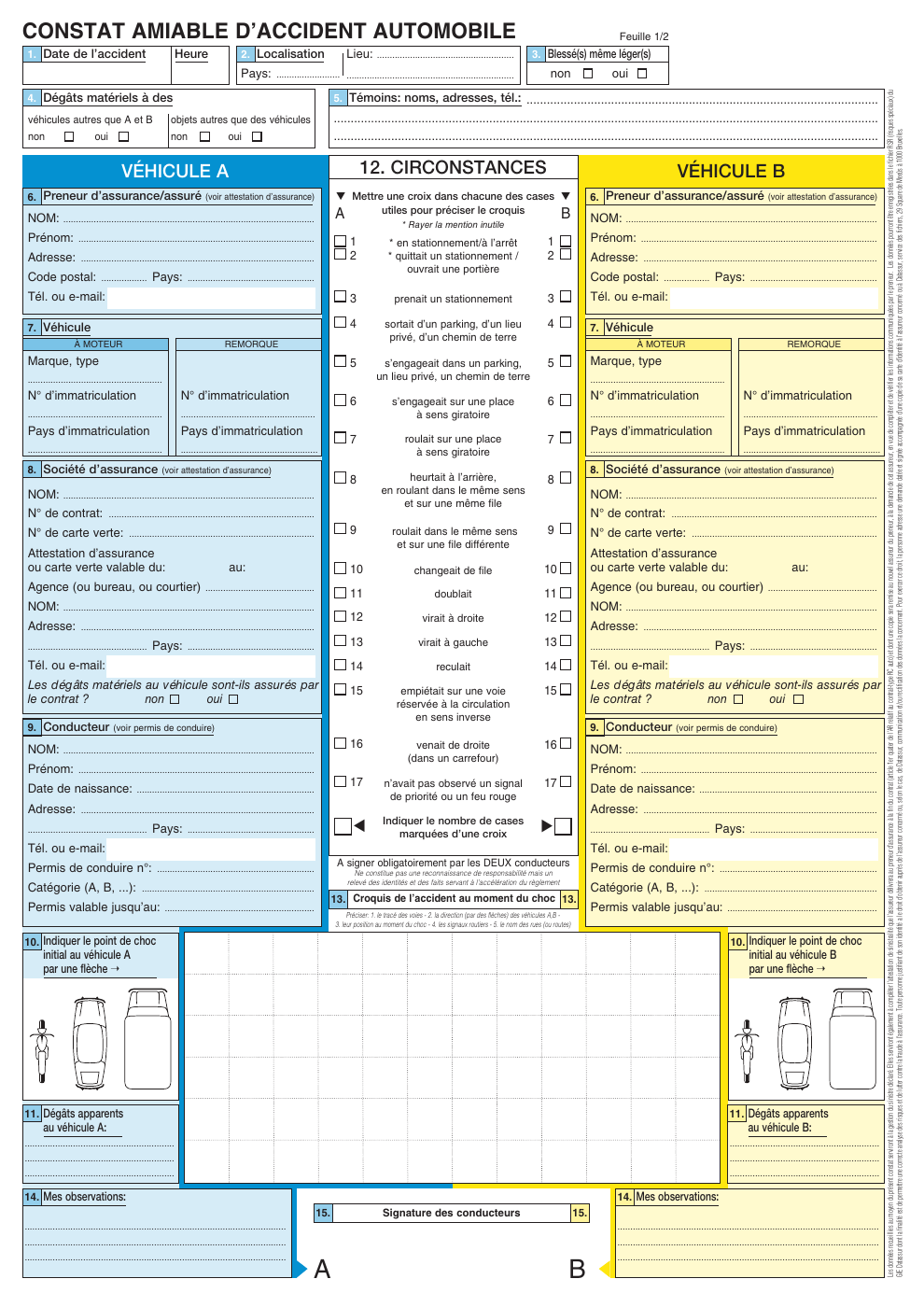
The original document is unchanged. The explanations below are a GAP guide, not a new official form. This PDF is intended for printing and has no interactive form fields.
Accident report
At the scene: practical steps
Safety and identification
Move to safety. Without putting yourself at risk, note or photograph the other vehicle’s registration and obtain contact details. Do not chase a fleeing vehicle: record what you observed and inform the police.
Photograph the facts
If safe, photograph vehicle positions before they are moved, damage, signs, road markings and surroundings. Safety and emergency-service instructions take priority. Obtain witnesses’ contact details.
Check documents
Together, record the insurer, policy number, registration and dates shown on the insurance certificate; a clear photograph can help. Dates alone do not establish that cover is effective. Keep documents for the claim and do not publish them.
Date, time and boxes matter
Describe observed facts, not assumed liability. Check the precise address, columns A/B, each box in section 12 and the total number ticked. An accurate report helps assessment but does not guarantee payment.
Draw a clear sketch
Show positions at impact, lanes and signs. Label A/B and explain arrows. Write « stationary » if that was the case: the absence of an arrow does not prove it. The arrow in section 10 marks the first impact point, not movement.
Different accounts?
Do not present conflicting drawings as one agreed account. If using two sketches, label them « version A » and « version B » and explain the disagreement in the observations. Separate statements may be needed. Ask GAP and, as appropriate, the police for advice.
Read before signing
Complete the report together and have both drivers sign at the scene when the content is agreed and circumstances allow. Never sign an inaccurate, incomplete or misunderstood report. Contact police for disagreements, refusal or document problems. Each keeps a copy; do not unilaterally amend the signed front.
Who determines liability?
Your role is to describe facts honestly. Signing the report is not an admission of liability. Insurers assess evidence and applicable rules; if a dispute reaches court, the judge decides. Notify GAP promptly and forward correspondence received.
What type of incident?
A and B identify the two parties; the letters do not assign blame. Use the same labels in the sketch, photographs and observations.
Between neighbours: record the affected properties, known or suspected source, discovery date, damage and home insurance details. Do not present a suspicion as an established fact. Do not tick traffic circumstances. GAP can help check whether a dedicated water-damage form is more appropriate.
Private life: identify the people, parents or representatives where a child is involved, what happened and damaged items. Record the relevant personal liability policy. The report describes facts; liability and cover remain to be assessed. Do not tick traffic circumstances.
The front, section by section
1Date and time
State when the incident happened as accurately as possible. If you discover damage later, distinguish discovery from its presumed time of occurrence.
2Location
Give country, town, street and useful landmarks. For a building, include floor, apartment and affected rooms.
3Injuries, even minor
Record known injuries without making a diagnosis. Put further details in the spaces provided. Emergency assistance takes priority.
4Other property damage
Distinguish vehicles A/B from other vehicles or objects. Identify owners and describe visible damage.
5Witnesses
Record the names and contact details of people who saw the event. Someone arriving afterwards is not necessarily an eyewitness.
6Policyholder / insured person
Copy the insured person’s details from the documents. The policyholder may differ from the driver or person who caused the damage.
7Vehicle
Record make, type, registration and country; include the trailer if relevant. Do not invent vehicle details for another type of claim.
8Insurance company
Give insurer, policy number and broker. For motor incidents, add insurance certificate details and validity. Check rather than guess the cover.
9Driver
Identify the person actually driving and their licence details. With no driver involved, explain people’s roles in observations.
10Initial impact point
Mark the first contact point on the vehicle diagram with an arrow. This is distinct from all damage. Without a vehicle, show the affected area in the sketch and observations.
11Visible damage
Describe what you can see without assuming hidden damage. Add clear photographs; an expert may identify further damage later.
12Circumstances
In each column, tick only statements matching the facts at the time. Cross out inapplicable wording where requested and count the ticks. These boxes do not apply outside traffic incidents.
The 17 circumstances in section 12
- Was parked or stationary.
- Was leaving a parking space or opening a door.
- Was parking.
- Was leaving a car park, private premises or dirt road.
- Was entering a car park, private premises or dirt road.
- Was entering a roundabout.
- Was circulating on a roundabout.
- Struck the rear while travelling in the same direction and lane.
- Was travelling in the same direction in another lane.
- Was changing lanes.
- Was overtaking.
- Was turning right.
- Was turning left.
- Was reversing.
- Encroached on a lane for traffic in the opposite direction.
- Was approaching from the right at a junction.
- Failed to observe a priority sign or red traffic light.
Outside a motor accident: Between neighbours: record the affected properties, known or suspected source, discovery date, damage and home insurance details. Do not present a suspicion as an established fact. Do not tick traffic circumstances. GAP can help check whether a dedicated water-damage form is more appropriate.
13Sketch
Show positions, directions, lanes and relevant signs at impact, labelling A/B. For other damage, a plan can explain the source or path of water.
14Observations
Add facts not properly described elsewhere, reservations and disagreements. Be clear; use a labelled attachment if needed.
15Signatures
Both parties read the front before signing. Signatures matter for the facts recorded. Do not sign an inaccurate or unclear account or change it unilaterally afterwards.
The reverse and additional pages
Pages 1 and 3 are the two copies of the front; pages 2 and 4 are the reverse-side statements. Page 5 provides extra space; page 6 contains instructions. Complete the reverse for your own insurer.
Police / official report
Record police involvement, service and known report reference.
Your vehicle
Use documents for chassis, usage and inspection details.
Repairer
Give garage details and whether the vehicle is immobilised.
Trailer
Complete its details only if relevant.
Usual driver
Explain the driver’s relationship to the insured and capacity at the time.
VAT
Answer according to the owner’s actual tax position and deduction entitlement. Ask for advice if unsure.
Injured people
Identify people by their location inside or outside vehicles, without inventing a diagnosis.
Other damage
Describe other property and give owners’ details.
Liability
Explain your reasoned understanding of the facts. The insurer assesses liability.
Insurance policies
List relevant policies and references without assuming they will pay.
Forms and bank details
State whether you have another blank report. Provide requested bank details only to the appropriate contact for your claim.
Date and signature
Date and sign your own statement and submit the requested supporting documents.
After completing the report
- Read both columns, ticks, sketch and observations before signing.
- Each party keeps a legible copy. Do not alter the signed front unilaterally.
- Send the report and photographs to GAP promptly under your policy arrangements. Do not wait for the final repair cost.
- The report is not confirmation of payment. The insurer assesses facts, liability and cover.